



ID :
514749
Tue, 12/04/2018 - 10:41
Auther :
Shortlink :
https://www.oananews.org/index.php//node/514749
The shortlink copeid
Russian spacecraft with new crew gets into near-Earth orbit
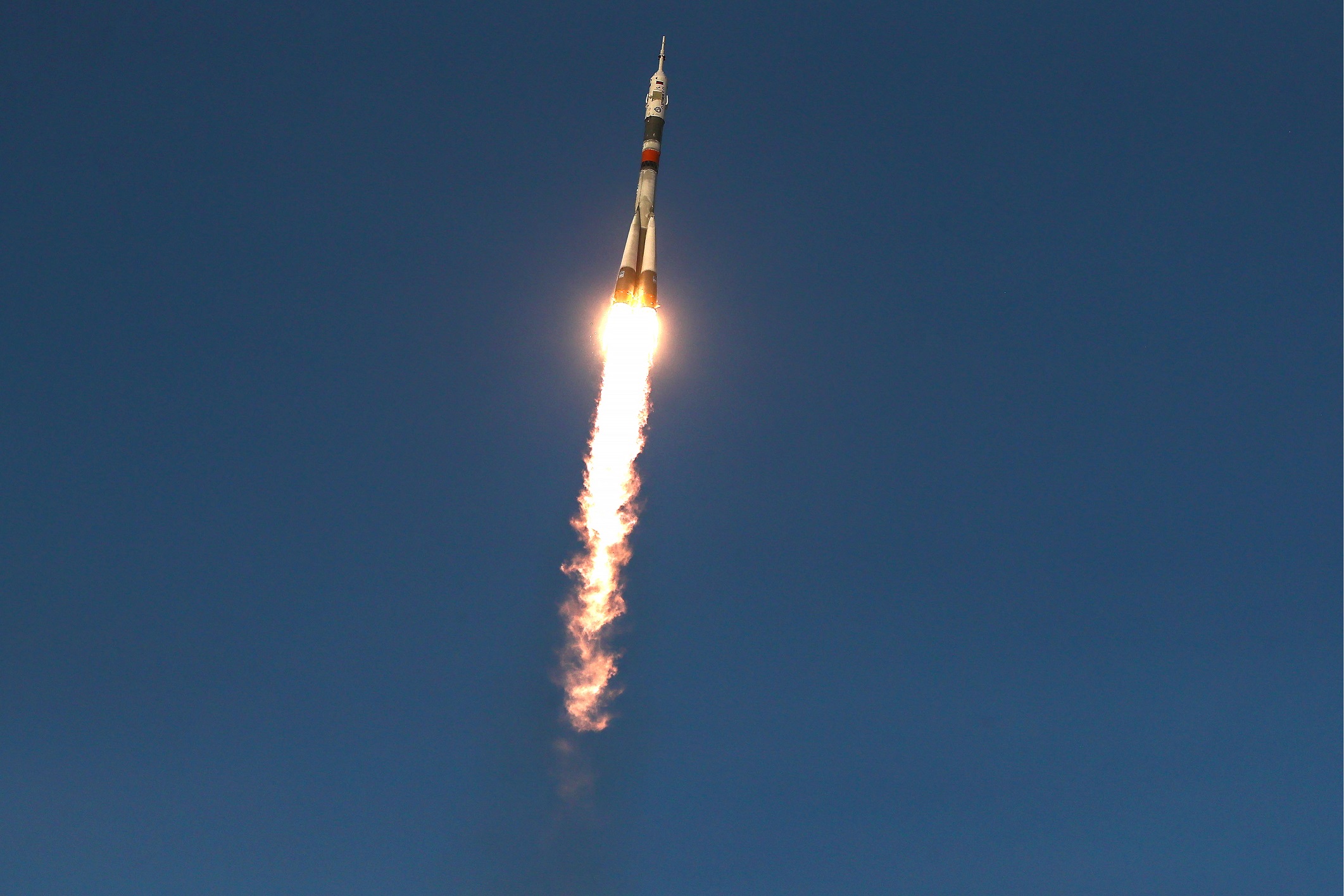
BAIKONUR /Kazakhstan/, December 3. /TASS/. The manned Soyuz MS-11 spacecraft with three crewmembers of the new expedition to the International Space Station (ISS) has entered the near-Earth orbit and started its autonomous flight to the orbital outpost, Russia’s State Space Corporation Roscosmos told TASS on Monday.
"The spacecraft separated from the third stage of the Soyuz-FG carrier rocket in a normal mode and at the designated time," Roscosmos said.
The Soyuz-FG carrier rocket with the manned Soyuz MS-11 spacecraft blasted off from the first launch site of the Baikonur Cosmodrome at 14:31 Moscow time.
The new expedition comprises Russian cosmonaut Oleg Kononenko, NASA astronaut Anne McClain and astronaut of the Canadian Space Agency David Saint-Jacques. The spacecraft is due to dock with the International Space Station at 20:36 Moscow time on Monday. The new crew will stay in orbit for 194 days.
This is the first launch of a manned spacecraft after the abortive blastoff of the Soyuz carrier rocket on October 11.
Soyuz abortive launch
A Soyuz-FG carrier rocket with a manned Soyuz MS-10 spacecraft blasted off from Kazakhstan’s Baikonur Cosmodrome to the International Space Station on October 11. On board the spacecraft were Russian cosmonaut Alexei Ovchinin (the commander of the Soyuz MS-10) and NASA astronaut Nick Hague.
Following a smooth liftoff, the Soyuz’s booster malfunctioned between the first and second stages of separating, whereupon the crew was forced to abort the flight and switch to ballistic descent. The manned Soyuz MS-10 spacecraft ended up landing in the Kazakh steppe.
The press office of Russia’s Central Military District reported that rescuers recovered the crew from the descent capsule. Later, the crewmembers were examined and found to be in good condition. After their medical check-up in the town of Baikonur, the astronauts were transported to Moscow.
This was the first emergency landing with this type of carrier rocket over the past 35 years.
NASA astronaut Nick Hague, who returned to Moscow from the Baikonur spaceport on October 12 after the Soyuz booster’s failure, flew to the United States on October 13.
As the emergency commission announced on November 1, the incident occurred after the nozzle lid of the oxidizer tank did not open due to the deformation of the stages’ separation contact sensor. The sensor was deformed during the assembly of the ‘package’ of the rocket’s first stage at the Baikonur Cosmodrome.
New crew’s work in orbit
During its stay on the orbital outpost, the new crew will carry out a lot of operations and 48 scientific experiments. In particular, the crew will work with the Russian Progress MS resupply ships, load and undock the commercial SpaceX DM1 cargo spaceship, work with the Boe-OFT resupply ship, load and undock the Russian manned Soyuz MS-09 spacecraft for the return of the ISS-56/57 crew (Roscosmos cosmonaut Sergei Prokopyev, NASA astronaut Serena Aunon-Chancellor and astronaut of the European Space Agency Alexander Gerst) to Earth, as well as to conduct onboard photo and video surveys of the flight.
The new crew’s research experiments will be devoted to physical and chemical processes and materials in outer space, the exploration of Earth and outer space, the study of the human organism in the conditions of an orbital flight, biology and bio-technology.
Also, Kononenko and Prokopyev are expected to make a spacewalk in the second ten-day period of December to inspect a hole in the manned Soyuz MS-09 spacecraft’s hull.
On August 30 a drop in air pressure was registered on the ISS. The crew examined the compartments and add-on modules one by one to identify a two-millimeter hole in the hull of the Soyuz MS-09 spacecraft attached to the orbital outpost. In the evening of the same day it was patched up with several layers of epoxy resin. Pressure returned to normal. On August 31 the crew reinforced the patch with another layer of sealant.
Earlier, the spacewalk to inspect the Soyuz spacecraft’s hole was planned for November 15 and Russian cosmonauts Prokopyev and Ovchinin were expected to have carried it out but Ovchinin did not travel to the ISS due to the Soyuz abortive launch on October 11.
Read more
