



Behind “religious freedom” rhetoric
Hanoi, December 24 (VNA) – With the latest update by the US Commission on International Religious Freedom (USCIRF), which once again gave biased and prescriptive assessments of religious freedom in Vietnam, a concept rooted in humanitarian values has continued to be distorted and politicised as a tool of pressure.
However, viewing the issue solely through the lens of a single report or organisation remains insufficient. In reality, behind claims made in the name of “human rights” lies a long-standing set of tactics aimed not at protecting freedom of belief or religion, but at undermining social stability, sowing divisions within the great national solidarity bloc, and smearingVietnam’s international image.
Identifying and exposing the misuse of the banner of “religious freedom” is not intended to deepen confrontation or deny differences, but to return this issue to its proper place — within Vietnam’s specific historical, cultural and legal context.
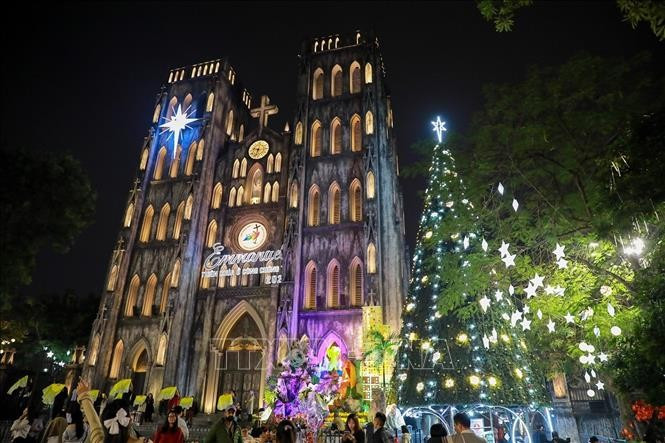
Vietnam is a multi-religion and multi-belief country where religions coexist peacefully, enjoy equality before the law, and have been closely connected with the nation’s history. Buddhism, Catholicism, Protestantism, Cao Dai, Hoa Hao, Islam, and other religions all have stable space for religious practice protected by law. The freedom of belief and religion is not a slogan but a constitutional right institutionalised through the 2016 Law on Belief and Religion and reflected in a vibrant religious life across the country. This reality is undeniable. Yet it is precisely this harmonious picture that hostile forces seek to exploit, turning the so-called “protection” of religious freedom into a political instrument.
A common tactic is to distort Vietnam’s religious policies and laws through activities of individuals, organisations and international forums. Under the guise of “human rights” or “religious freedom”, certain reports deliberately absolutise religious freedom, separating it from the legal framework and social order. State management measures designed to safeguard the rights and legitimate interests of the community are mischaracterised as “interference”, “restriction” or “repression”.
Annual USCIRF reports, for many years relying largely on information from overseas opposition groups and self-proclaimed “religious activists”, have repeatedly misrepresented Vietnam’s religious reality, interpreting religious issues through subjective and biased perspectives. Despite being publicly refuted by Vietnam on multiple occasions, these narratives are recycled as a template, creating a distorted image among audiences unfamiliar with the country’s religious context.
Another dangerous tactic is the deliberate magnification of differences or isolated frictions within or between religious communities to undermine national solidarity. Historical legacies, local-level disputes or administrative shortcomings in some localities are selectively stripped of context and labelled as “religious conflicts” or “discrimination”. This approach has been persistently applied to land-related issues involving religious facilities, where administrative or legal disputes are recast as allegations of “land seizure” or “religious repression”, fuelling antagonism between believers and authorities. Such misinformation continues to circulate widely online despite transparent legal disclosures and dialogue by competent agencies.
More alarmingly, in areas of strategic importance to national defence and security, especially those with ethnic minority populations, reactionary elements have exploited religion to incite separatist or autonomous ideologies. Under the banners of “religious freedom” or “self-determination”, they promote radical political agendas, fabricating illusory visions of “separate states” or “independent religions”. Schemes such as the so-called “De Ga State” in the Central Highlands, “Mong State” in the Northwest, or the revival of a “Champa kingdom” are the results of organised and long-term subversive activities with external backing. The terrorist attack in Dak Lak on June 11, 2023, which claimed the lives of officials and civilians, stands as a tragic example of the consequences of politicised and extremist misuse of religion.
Another recurring tactic is the religiousisation of socio-economic issues or individual violations of the law. When individuals abusing religious cover are lawfully dealt with, hostile forces immediately label such cases as “arresting believers” or “repressing religion", deliberately conflating individual misconduct with entire religious communities. In several instances cited in USCIRF’s 2024 report, individuals associated with unrecognised religious groups in the Central Highlands were prosecuted for violations related to the illegal organisation of religious activities. These cases were misrepresented as “religious persecution”, ignoring their legal nature and Vietnam’s principle of equality before the law.
Equally concerning is the emergence of pseudo-religious groups and cults operating under the guise of religion or belief to disrupt social order, particularly in remote and disadvantaged areas.
Authorities in northern mountainous provinces like Lao Cai, Dien Bien, and Ha Giang have recently addressed activities of groups such as “Gie Sua” (Church of Jesus) “Ba Co Do”, “Duong Van Minh” and “Giao hoi Duc Chua Troi Toan Nang" (Church of Almighty God or Eastern Lightning), which exploit vulnerable populations to spread superstition, discourage productive labour and incite anti-society behaviour. These groups even propagated distorted narratives about the “end of the world” or “spiritual salvation” intertwined with anti-government agendas. As a result, many families have fallen into prolonged rifts and conflicts, suffered economic decline, and caused disruptions to village order.
When local authorities intervene in accordance with the law, these actions are again mislabelled as “religious repression”, masking the real risks posed by such groups. If not promptly identified and prevented, pseudo-religious cults can become fertile ground for ringleaders to spread separatist and subversive ideas, running counter to moral values, cultural traditions, and the common interests of the community.
Recognising these tactics is essential not to negate religious diversity, but to ensure an objective understanding of religious freedom within Vietnam’s concrete realities. When religious life is viewed comprehensively — from the peaceful and vibrant practices of faith communities to the legal framework protecting citizens’ rights — distorted narratives, no matter how polished in the language of “human rights”, will inevitably stand in stark contrast to the reality of a tolerant and harmonious religious landscape in Vietnam today./.
